

Ionic Compound Of Magnesium Oxide
Properties of Ionic and Covalent Compounds
- Ionic and covalent compounds differ in their properties because the particles in each of these 2 compounds are held together past dissimilar types of chemical bonds.
- Table compares and contrasts the backdrop of ionic and covalent compounds.
Covalent compounds Ionic compounds (composed of simple molecules) (a) Have high melting and boiling points (a) Havelowmelting and boiling points (b) Be as solids at room temperature.
Non-volatile(b) Usually exist every bit liquids or gases at room temperature.
Volatile(c) Conduct electricity in the molten land or in an aqueous solution only do not behave electricity in the solid state
(c) Do non deport electricity in the solid and liquid states (d) Commonly soluble in water only insoluble in organic solvents such as ether, booze, benzene, tetrachloromethane, propanone and other (d) Usually insoluble in h2o just soluble in organic solventssuch as ether, booze, benzene, tetrachloromethane, propanone and other
Explaining the melting and boiling points of ionic compounds
-
- Table shows the melting and humid points of some ionic compounds.
Ionic chemical compound Melting signal (°C) Boiling point (°C) Calcium oxide, CaO 2580 2850 Magnesium chloride, MgCl2 714 1412 Sodium fluoride, NaF 993 1695 Aluminium oxide, Al2O3 2030 2970 Sodium chloride, NaCl 801 1420 - The melting and humid points of ionic compounds are high.
- Table shows the melting and humid points of some ionic compounds.
- The high melting and boiling points of ionic compounds can be explained as below:
- Ionic compounds are composed of oppositely-charged ions (positive and negative ions) arranged in a three-dimensional giant crystal lattice.
- The oppositely-charged ions are held together past strong electrostatic forces of attraction, known as ionic bonds.
- A lot of heat free energy is needed to break the strong ionic bonds during melting or humid.
- Hence, ionic compounds have high melting and boiling points with low volatility.
People also ask
- Chemical Bonding and Compound Germination
- Chemical Bonding
- What is Covalent Bond?
- How is covalent bond is formed?
- Describe how to write a formula for a covalent compound
- What causes ions to form ionic bonds?
- Explain the formation of ionic bonds with examples
- How do you write the formula for ionic compounds?
- How practise you Name an Ionic Chemical compound?
Explaining the melting and humid points of covalent compounds
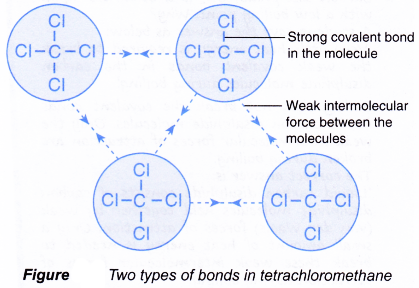
- Covalent compounds are composed of molecules.
- The bonding in these covalent compounds consists of
- strong covalent bonds between the atoms in the molecule.
- weak forces of allure betwixt the molecules.
- An instance is shown in Figure. Information technology shows the two types of bonds in liquid tetrachloromethane, CCl4.
- Table shows the melting and boiling points of 4 covalent compounds.
Covalent compound Melting point
(°C)Boiling betoken
(°C)Ethanol, C2H5OH -117 78 Tetrachloromethane, CCl4 -23 76.8 Ammonia, NH3 -78 -33 Methane, CH4 -182 -164 - The melting and humid points of covalent compounds are depression.
- Table shows the melting and boiling points of 4 covalent compounds.
- The low melting and humid points of covalent compounds can exist explained every bit below:
- In a covalent compound, the covalent molecules are held together past weak forces of allure.
- A small amount of estrus free energy is required to overcome the weak intermolecular forces of attraction during melting or boiling.
- Hence, the covalent compound has low melting and boiling points with loftier volatility.
Explaining the electrical electrical conductivity of ionic compounds
- The electrical electrical conductivity of ionic compounds in the solid state can be explained as beneath:
- Ionic compounds are composed of oppositely-charged ions.
- In the solid state, the positive and negative ions are locked in fixed positions and cannot movement freely.
- Hence, ionic compounds cannot carry electricity in the solid state.
- The electrical conductivity of ionic compounds in the molten (liquid) and aqueous states can be explained beneath:
- When the ionic compounds are melted through heating or dissolved in water, the positive and negative ions will break free and become mobile, that is able to move freely.
- The presence of gratuitous mobile ions enable ionic compounds to conduct electricity in the molten or aqueous states.
Explaining the conductivity of covalent compounds
- Tabular array shows the electrical conductivity of a few covalent compounds.
Covalent compound Electric conductivity Solid Liquid Glucose Non usher Non usher Acetamide Non conductor Not conductor Napthalene Non usher Non usher Tetrachloromethane Not conductor Non conductor - The electrical conductivity of covalent compounds in the solid and liquid states tin can be explained as below:
- Covalent compounds are equanimous of simple covalent molecules in the solid and liquid states.
- In that location are no free mobile ions in these two states.
- Hence, covalent compounds cannot behave electricity in the solid and liquid states.
Explaining the solubility of ionic compounds
- The solubility of ionic compounds in water tin can be explained as beneath:
- Ionic compounds are composed of ions.
- The ions are easily hydrated past water molecules to class hydrated ions.
- The hydration of ions past h2o molecules liberates heat energy.
- Equally a event, ionic compounds are usually soluble in water.
- The solubility of ionic compounds in organic solvents can be explained as below:
- Organic solvents such as ether, alcohol, benzene and tetrachloromethane consist of covalent molecules which cannot hydrate ions.
- Equally a issue, ionic compounds are insoluble in organic solvents.
Explaining the solubility of covalent compounds
- The solubility of covalent compounds in water can be explained equally below:
- Covalent compounds consist of covalent molecules.
- Water cannot hydrate covalent molecules.
- Hence, covalent compounds are ordinarily insoluble in h2o.
- The solubility of covalent compounds in organic solvents tin be explained as below:
- Covalent molecules in covalent compounds and organic molecules in organic solvents are both held together by weak intermolecular forces of allure.
- As a consequence, the covalent molecules in the covalent compounds are easily miscible with the organic molecules in the organic solvents because they have the same type of weak intermolecular forces of attraction.
- Hence, covalent compounds are unremarkably soluble in organic solvents.
Properties of Ionic and Covalent Compounds Experiment
Aim: To compare the properties of ionic and covalent compounds.
Materials: Magnesium chloride crystals, sodium sulphate crystals, solid atomic number 82(II) bromide, diethyl ether, hexane, cyclohexane, distilled water and naphthalene.
Apparatus: Scout glasses, dropper, test tubes, crucible, battery, bulb, switch, Bunsen burner, tripod stand up, carbon electrodes, pipe-clay triangles, connecting wires with crocodile clips and beaker.
Procedure:
A. Melting and boiling points
- One-half spatula of magnesium chloride crystals and sodium sulphate crystals are placed separately in two different scout spectacles. The physical country of each substance is recorded.
- 3 drops of diethyl ether and hexane are placed separately in 2 dissimilar watch glasses. The physical country of each substance is recorded.
- All the spotter spectacles are left aside for 5 to 10 minutes. All the changes are recorded.
- Inferences regarding their volatility, melting and boiling points are made based on the observation.
B. Solubility in water and organic solvents
- A quarter spatula of magnesium chloride crystals are placed in a examination tube.
- v cmthree of distilled water is added to the test tube.
- The mixture in the examination tube is shaken well.
- All the changes are recorded.
- Steps one to 4 are repeated using liquid cyclohexane to replace distilled water.
- Steps 1 to five are repeated using 5 cm3 of diethyl ether to replace the magnesium chloride crystals.
C. Electric conductivity
- A crucible is filled with solid atomic number 82(Ii) bromide until it is half total.
- The appliance as shown in Effigy is set.
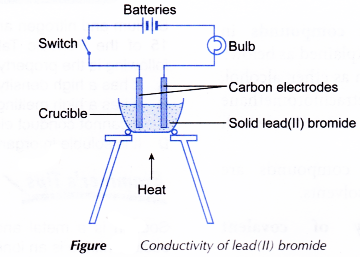
- The switch is turned on. The observation on whether the bulb glows and the changes at the electrodes (if any) are fabricated.
- The switch is then turned off. The solid lead(II) bromide in the crucible is heated until it melts completely.
- The switch is turned on again. The observation on whether the bulb glows and the changes at the electrodes (if any) are made.
- Steps 1 to 5 are repeated using solid naphthalene to supplant solid lead(II) bromide.
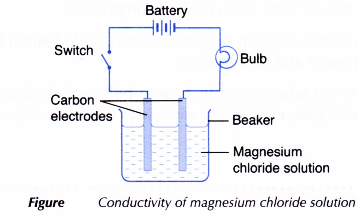
- Another test on the electrical conductivity of aqueous magnesium chloride solution is carried out by setting up the appliance as shown in Figure. Observation on whether the bulb glows and the changes at the electrodes (if any) are recorded.
Results:
A. Melting and boiling points
| Substance | Observation | Inferences |
| Magnesium chloride crystals | The substance remains as a white solid even after 10 minutes. | Magnesium chloride has high melting and boiling points. It is non-volatile. |
| Sodium sulphate crystals | The substance remains equally a white solid even after ten minutes. | Sodium sulphate has high melting and boiling points. Information technology is non-volatile. |
| Diethyl ether | The colourless liquid disappears/vaporises and the scout drinking glass becomes dry out after x minutes. | Diethyl ether has low melting and boiling points. It is volatile. |
| Hexane | The colourless liquid disappears/vaporises and the watch glass becomes dry after 10 minutes. | Hexane has depression melting and humid points. It is volatile. |
B. Solubility in water and organic solvents
| Substance | Observation | Inferences | |
| Solubility in h2o | Solubility in cyclohexane | ||
| Magnesium chloride | The white solid dissolves in water to form a colourless solution. | The white solid does not deliquesce in cyclohexane. | Magnesium chloride is soluble in h2o simply insoluble in cyclohexane. |
| Diethyl ether | 2 layers of colourless liquids are formed. | The colourless liquid dissolves in cyclohexane to form a colourless solution. | Diethyl ether is insoluble in water but soluble in cyclohexane. |
C. Electrical conductivity
| Substance | Land of substance | Observation | Inferences | |
| The bulb | Changes at the carbon electrodes | |||
| Lead(II) bromide | Solid | The seedling does not glow. | No change | Lead(2) bromide cannot carry electricity in the solid state just tin comport electricity in the liquid state. |
| Liquid/molten | The seedling glows brightly. | A ruby-brown vapour is liberated at one of the electrodes. | ||
| Naphthalene | Solid | The bulb does non glow. | No modify | Naphthalene cannot conduct electricity in the solid and liquid states. |
| Liquid/molten | The bulb does non glow. | No change | ||
| Magnesium chloride | Aqueous solution | The bulb glows brightly. | Bubbles of gas are liberated at both the carbon electrodes. | Magnesium chloride tin can bear electricity in the aqueous solution. |
Discussion:
- Magnesium chloride crystals and sodium sulphate crystals are ionic compounds. They are made up of positive and negative ions which are attracted together past potent ionic bonds. A lot of rut energy is needed to overcome these bonds during melting or boiling. Hence, they accept high melting and boiling points and are non-volatile.
- Diethyl ether and hexane are covalent compounds. They consist of molecules that are attracted to each other by weak intermolecular forces. Lilliputian heat energy is needed to overcome these weak forces during melting or boiling. Hence, they have low melting and humid points and are volatile.
- Magnesium chloride, as an ionic compound, is
- soluble in h2o, but
- insoluble in cyclohexane (organic solvent).
- Diethyl ether, as a covalent chemical compound, is insoluble in water, just soluble in cyclohexane (organic solvent).
- In solid lead(2) bromide (an ionic compound), the lead(2) ions and bromide ions are closely packed at fixed positions in an orderly manner. Hence, the ions do not movement freely. As a event, solid lead(II) bromide cannot bear electricity.
- In molten atomic number 82(II) bromide, the lead(II) ions and bromide ions are mobile or tin can motility freely. Hence, molten lead(II) bromide can behave electricity.
- Magnesium chloride (an ionic compound) ionises completely in an aqueous solution to become free mobile magnesium ions and chloride ions. Hence, an aqueous solution of magnesium chloride tin can conduct electricity.

- Naphthalene, every bit a covalent compound, is made up of covalent molecules only. Hence, information technology cannot conduct electricity in the solid and liquid states.
Determination:
- Ionic compounds are non-volatile and have high melting and boiling points. They are usually soluble in water merely insoluble in organic solvents. They tin conduct electricity in the molten and aqueous states.
- Covalent compounds are volatile and accept depression melting and humid points. They are usually insoluble in water but soluble in organic solvents. They cannot comport electricity in the solid and liquid states.
Types of covalent molecules
- In that location are ii types of covalent molecules.
(a) Simple molecules such equally water, carbon dioxide, ammonia and tetrachloromethane.
(b) Macromolecules or behemothic molecules such as silicon dioxide and diamond. - Figure shows the structures of diamond and silicon dioxide.
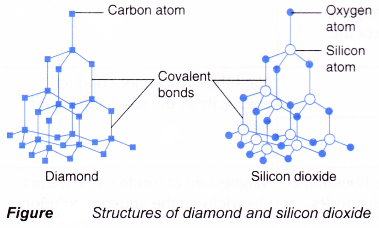
- In a macromolecule, all the atoms are bonded to each other by covalent bonds in a giant lattice structure.
- These macromolecules
(a) have loftier melting and boiling points considering a lot of oestrus energy is needed to suspension the strong covalent bonds in the behemothic lattice structure.
(b) cannot conduct electricity because they practise non have free mobile ions.
(c) are insoluble in h2o.
Uses of covalent compounds as solvents
- Many covalent compounds have depression melting and humid points. Hence, they be as liquids at room temperature and are volatile.
- Covalent compounds in the course of liquids are generally used every bit solvents in our daily life. Most of these liquids are organic compounds. They are known as organic solvents.
- Examples of some common organic solvents are alcohols such every bit ethanol, ethers such as dimethyl dimethyl ether, propanone, chloroform (trichloromethane), turpentine and petrol.
- Organic solvents are used
(a) as solvents to prepare solutions.
(b) to remove and clean dirt on surfaces which cannot be removed past water. - Table lists out the uses of some organic solvents.
Solvents Uses Turpentine To dissolve paint Petrol and kerosene As solvents to remove greasy or oil dirts Alcohols, propanone and turpentine As solvents to prepare varnish, shellac and lacquer Alcohols As solvents in medicine such as iodine solution Ethers As solvents in the extraction of chemicals from aqueous solutions Propanone To remove nail varnish Chlorofluorocarbons
(Cfc)As solvents to clean computer circuit boards Alcohols and ethers As solvents for ink and dyes Alcohols, ethers and propanone Equally volatile solvents in the preparation of cosmetic products such as perfumes - Well-nigh organic solvents such every bit benzene, chloroform and propanone are poisonous and harmful.

Ionic Compound Of Magnesium Oxide,
Source: https://www.aplustopper.com/properties-ionic-covalent-compounds/
Posted by: coatsallyne.blogspot.com
0 Response to "Ionic Compound Of Magnesium Oxide"
Post a Comment